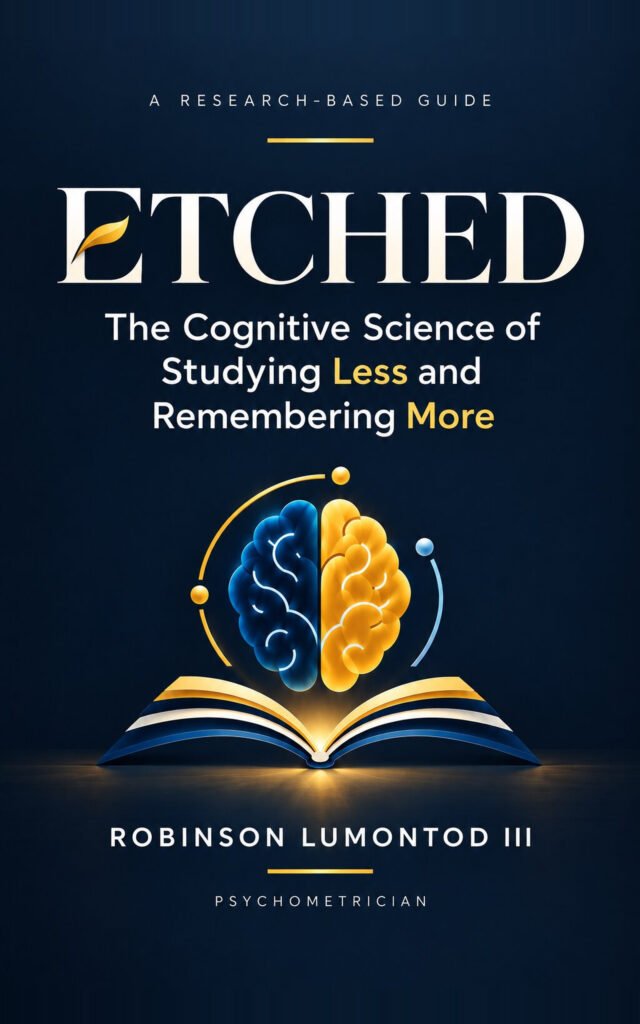
Etched is a book about the difference between studying that feels productive and studying that works. Those two things come apart more often than anyone tells you, and the gap between them is where good students lose marks they had already earned.
Every technique in it is tied to a named published study. The references are listed in full at the back, so you can go and read the research yourself rather than take my word for it.
Who it is for
- Students who are already working hard and not seeing it in their marks.
- Anyone facing a large syllabus and a fixed date — finals, comprehensives, a licensure exam.
- Teachers who want to know what the evidence actually supports.
Try the argument before you buy it
The whole book rests on one claim you can test in sixty seconds: what you can recognise and what you can produce are not the same thing, and only one of them is what an exam measures.
Try it now
This shows you the difference between what you recognise and what you can actually produce. About 1 minute
- Pick something you studied this week.
- Close your notes. Really close them.
- Write down everything you remember, until you run dry.
An exam asks you to produce, not to recognise. This is a one-minute test of which one your studying has been building.
Think of something you studied this week. Close your notes. Write down everything you remember.
What is inside
Twenty-nine chapters in six parts, plus two appendices. The parts are ordered so that the earlier ones change the most for the least effort — if you read only Parts I and II and stopped, you would already be studying differently.
Part I — Why your studying isn’t working
Why the techniques that feel most productive are the ones doing the least, and how that illusion is built.
- 1. The Fluency Trap
- 2. Desirable Difficulties
- 3. Five Things You Were Told That Aren’t True
Part II — The core four
The four methods with the strongest evidence behind them. Adopt these and you could stop reading here.
- 4. Retrieval Practice
- 5. Spacing
- 6. Interleaving
- 7. Elaboration and Self-Explanation
Part III — Seven techniques you have not been taught
Well-supported methods that almost never reach students, including several that sound wrong until you see the evidence.
- 8. Fail the Test Before You Study
- 9. Draw It
- 10. Say It Out Loud
- 11. Quiz Yourself Mid-Lecture
- 12. Exercise Four Hours Later
- 13. Sleep Is a Study Session
- 14. Judge Your Learning Late, Not Early
Part IV — Playbooks by subject
The same principles, applied differently depending on what you are actually studying. Anatomy and calculus do not want the same treatment.
- 15. Memorization-Heavy Subjects
- 16. Problem-Based Subjects
- 17. Reading Dense Texts
- 18. Papers, Reports, and Theses
Part V — The system around the studying
Everything that decides whether the methods in Parts II and III ever get used: your notes, your phone, your calendar, the people around you, and what you believe about your own ability.
- 19. Note-Taking That Feeds Retrieval
- 20. Attention and Your Phone
- 21. Procrastination Is Not a Willpower Problem
- 22. Test Day
- 23. Using AI Without Making Yourself Stupider
- 24. Studying With Other People
- 25. Motivation, Ability, and What to Believe About Yourself
- 26. Learning From Returned Work
- 27. Planning a Semester
Part VI — Putting it together
One change per week, sequenced so that it survives a bad week, and the trackers to run it with.
- 28. The 30-Day Plan
- 29. Templates and Trackers
Appendices
- A. What Didn’t Replicate
- B. References
Appendix A is the one I would read first if I were deciding whether to trust this book. It lists the study-skills findings that did not survive replication, including some I would have liked to keep, and says plainly why they are not in the other twenty-nine chapters.
About the author
Robinson Lumontod III is a registered psychometrician and a university instructor. He wrote this book after failing to remember most of what he read while preparing for his own licensure exam.